
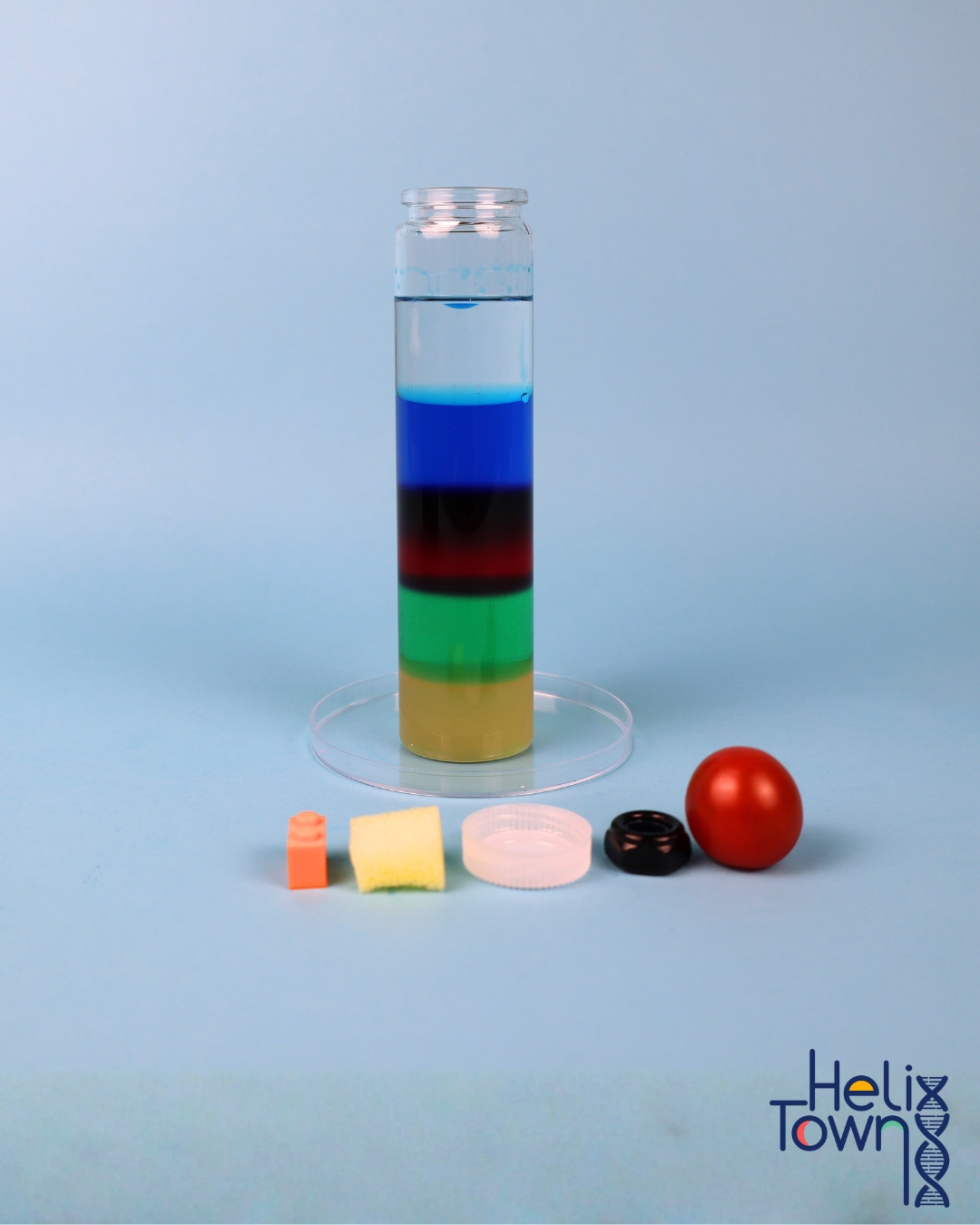
Materials
- ¼ cup (60 mL) corn syrup
- ¼ cup (60 mL) dish soap
- ¼ cup (60 mL) water
- ¼ cup (60 mL) Rubbing alcohol (70%)
- ¼ cup (60 mL) baby oil
- Food coloring
- Tall, clear glass or container
- Spoon
- Metal screw
- Cherry tomato
- Plastic bottle cap
- Small piece of sponge
- LEGO piece
- Metal nut
Instructions
- Slowly pour ¼ cup of corn syrup into the bottom of a tall, clear glass. Let it settle.
- Carefully add ¼ cup of dish soap. Pour it slowly down the side of the glass or over the back of a spoon to keep the layers from mixing.
- Slowly add ¼ cup of water (mixed with red food coloring) in the same way. Let the layers settle before continuing.
- Carefully pour in ¼ cup of rubbing alcohol (mixed with blue food coloring) over the back of a spoon.
- Finally, slowly add ¼ cup of baby oil. It should form the top layer.
- Let the density tower sit undisturbed for a few minutes until the five layers are clearly visible.
- Before adding the objects, look at the cherry tomato, plastic bottle cap, sponge, LEGO piece, and metal nut. Predict what will happen to each one. Will it float at the top, stop somewhere in the middle, or sink to the bottom?
- Drop the objects into the tower one at a time and watch what happens. Give each object time to settle before adding the next one.
- Compare your observations with your predictions. Did all the objects end up where you expected?
What’s going on?
- Each liquid has a different density, which is the amount of mass packed into a certain volume. Denser liquids tend to sink below less dense liquids. In this density tower, corn syrup is the densest, so it settles at the bottom, followed by dish soap, water, rubbing alcohol, and baby oil, which is the least dense and floats at the top.
- The objects also have different densities. An object will sink through a liquid if it is denser than that liquid and float if it is less dense. This is why some objects may stay near the top, some may settle between two liquid layers, and others may sink all the way to the bottom.
- Density isn't the only thing that can affect what you observe. Shape, trapped air, and how well a liquid wets an object's surface can also influence where an object ends up. This is especially important for objects such as the sponge and bottle cap. For example, the sponge contains a lot of trapped air, which lowers its overall density and makes it float highest.
Safety
- Rubbing alcohol is flammable. Keep the experiment away from flames, sparks, and heat. Do not drink or taste any of the liquids, and wash your hands after handling the materials. Adult supervision is recommended.
Tried this experiment?Please consider Leaving a Review!